Convolutional Neural Network for photon identification
Implementation of a DNN architecture to solve a binary classification.

This project encompasses the development of a Convolutional Neural Network framework, the build of the data pipeline, its deployment and the statistical consistency to identify photons. It began as my Master Thesis project and, due to the great potential the ATLAS team saw on it, it later evolved to become part of my PhD.
The task of correctly identifying photons from events, plays a fundamental role for the collaboration since photons are one of the main objects used in all searches (analysis) directly or indirectly across every experiment. So far, the obtained results are astonishing when compared to previous implementations, getting an overall over 20% improvement.
The problem of identifying objects in the experiment can be frame as a typical Data Mining one,
in this case we are concerned on mapping raw data to high level classes that we identify as particles.
The raw data is for us the signal deposited in the detector by the particles after the beam interaction,
which can be measured by position variables (features), magnetic moment, and energy deposited.
 The current baseline to identify particles takes these raw features and builds higher level features called ShowerShapes Variables.
In this project approach we remove the need for these variables,
instead we input the raw energy deposits as images to the classifier.
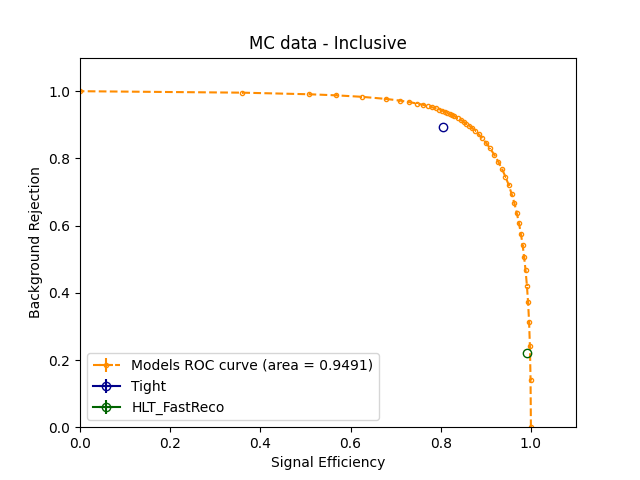 The project outcome was a classifier tool for photons that is deployed using the ONNX format for the CNN model.
Objects in ATLAS are stored in a NoSQL file format that has a directory structure of custom objects representing an event.
The tool is fed with this files,
from where it reads the raw features and processes them to input a heatmap (energy distribution) to the CNN.
The model was fully developed using TensorFlow & Keras in a custom and dynamic manner.
Both the Signal Efficiency (Recall) and Background Rejection show remarkable improvements with respect to the baseline tool. In particular we showed for a set Background Rejection a 20% improvement in the Signal Efficiency against the baseline all the coordinate range.
The full framework has been developed using C++, Python, Keras & TensorFlow. Some of the key Python libraries used are: PyRoot, uproot, scikit-hep, Matplotlib, Pandas, Numpy & Numba.